

Ravenna is the capital city of the Province of Ravenna in the Emilia-Romagna region of Italy, and is the target for today's high-octane team and I. It's known for its early Christian monuments and mosaics, eight of which are inscribed on the World Heritage List. Much of the art is Byzantine in style Although I didn't manage to visit all the sites, I managed to visit the majority.

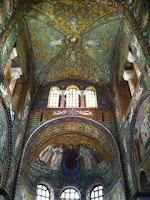
The day started with a visit to the Basilica of San Vitale (548) with its Byzantine architecture and mixture of mosaics, frescos and mouldings. The architecture is very similar to the Hagia Sophia in Constaninople, unsurprising as both sites were created under the reign and guidance of Justinian I and Theodora, his wife. In addition to a glorious range of ecclesiastical mosaics, there are two striking groups either side of the apse portraying these two benefactors. Whilst Justinian is very much as you would expect a Roman Emperor to look (suave, debonair and slightly dissolute), Theodora is a sad disappointment and looks bad tempered and mean - not at all the legendary beauty who started life as a prostitute and trapped herself an emperor!


From there onto the Mausoleum of Galla Placidia (c. 430), a small very Greek Orthodox looking building in the courtyard of the Basilica. Once inside, the ceiling and walls are covered with the most incredibly vibrant and rich colored mosaics of incredible fineness. The site is controlled carefully to ensure that the microclimate is not too disrupted, but to be honest, I'm really not convinced the approach is particularly valid, as the door is wide open and people traipse in and out throughout the day.
Final stop of the morning was the city museum with a fine collection of orthodox christian artwork to view.

By this time, I was ravenous and also incredibly thirsty, as Ravenna was hot despite the sea breeze. It had become abundantly clear that any weight I had managed to lose earlier in the journey was going to be re-acquired with a vengeance, courtesy of the Italian staple diet of pizza and pasta, but hey, if you are going to have to pay later, you may as well enjoy the now to the hilt - so lunch was saffron, clams and parmesan gnocchi with a side platter of grilled vegetables!


From lunch, time for a quick visit to Dante's tomb ( as in 'Dante's Inferno'). As the Ravennans did not find the ivy covered mound sufficiently elaborate for such a famous wordsmith, they have constructed a small marble temple just outside it before continuing on to the Basilica of Sant'Apollinare Nuovo (c. 500).

From the outside it is a unassuming and plain mediterranean church, but once inside in the cool shadows, once again you realise it's covered with spectacular mosaics. Interestingly, one wall is lined with male saints, each with a unique face, hairstyle and haircolor; the other is lined with female saints, all with the same face, and almost entirely blond. I know Italians are famous for their dark hair, but almost all medieval art seems to portray the women with blond or mousy hair!

The Arian Baptistry (c. 500) and Neonian Baptistery (c. 430) are small chapels, adjacent to other churches or community centres.....more mosaics!!

The main Franciscan church is plain and sombre by comparison to the bright complexities of all these early churches, but it had its own little surprise in store for us - head on down under the main altar, into the crypt and voila.....ancient mosaic'd goldfish pond!! Complete with goldfish!

By now we were all starting to flag a little, and decided to head back to the 'van with a brief stop at the 'House of Stone Carpets' - a 14 roomed roman villa excavated over the last few decades and with superb mosaic floors. It's most spectacular center piece is known as the dance of the 4 seasons and depicts enthusiastic folk dancing to the tunes played by accompanying musicians.

After all the color and vibrancy the Mausoleum of Theodoric (520), was really a bit of a let down - it was a large marble building some way out of town with little to no remaining decoration. Despite all of Theodoric's power, it appears he was actually buried in a bathtub - albeit a very very large porphyry one! Do the dead sing in the bath?

Last stop of the day was the Basilica of Sant' Apollinare in Classe (549) before heading off on the long drive down towards Tarquinia.
My satnav is known to be a little dodgy so my passengers decided to opt for good old fashioned map based navigation, which ended up taking us across the Apennine Hills at the Muraglione Pass. It's a gloriously twisty windy hairpin bendy road, with lots of steep ascents and descents, and probably had the most amazing views - but by the time I managed to baby the van up the hills, the dark had settled, and nothing was in sight! As we started to descend on the other side of the hills, I decided to call it quits for the night driving and we wildcamped next to a ghostly glowing TV set, discarded randomly in the middle of a nature reserve.....

 I used the back plate of an old broken pendulum clock bought from the Kringloopwinkel (recycling store) for pennies as my base plate. Since I had substantially more blue'n'white than green'n'brown shards, I painted the plate brilliant white with some left over household wall paints. I laid out a couple of trial layouts , allowing me to experiment with the balance of the shapes, and to decide on the individual display direction. Some epoxy based glue and some sticky fingers later, the final layout was secured into place. Then the fun part - filling the gaps with grouting. I used a pure white grouting - I know many professional mosaicists mutter about it looking like kiddie craft projects, but guess what - I'm a big kid having fun, and the contrast was much better given the large amounts of delftware.


