
Today, I attained a new status with my travelling partners - I am now officially the Madonna of the Kittens.


 Today, I decided that the dormouse had the right idea, and whilst I have no intention of ending up in a Roman's dinner, - I slept. For about 20-odd hours. Think I needed that! On waking up, I rejoined the rest of the high octane team, and we headed up to San Luca for dinnner. It's a gorgeous church which contains an image of the Virgin Mary which is reputed to have been painted by St Luke, but has been dated as medieval. Nearby is a glorious restaurant which does very very nice cheese platters and delicious pizza.


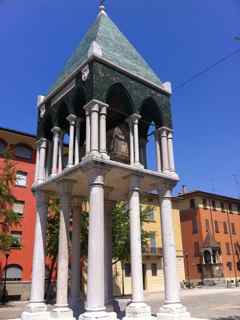 Bologna is the home of the oldest university in the world and was the first university to grant a degree to a woman (yay!). For those who qualified as doctors they were allowed to have the walls and ceilings of the university decorated with their heraldry and their place of origin - fascinating to see how the 'countries' of Europe evolve over the centuries. Of course, if you continue on to a doctorate and even a professorship or a Chair at the University , you are granted the high honor of being buried in midair. I hope the dead don't suffer from fear of height - and I have to say that the tombs seem to be something straight out of Terry Pratchett's Unseen University.
 From there, on to St Stefano, the holiest place in Bologna which is a conglomeration of multiple churches into one large church. In the Middle Ages, it's where all the relics were stored, and one of the churchs is the oldest church in Bologna. Out of interest the blue and white patch on the column is a surveyor's sighting point for ensuring that earthquakes don't cause too much movement or subsidence - not a common point in English historical monuments!

 From St Stefano, we headed off to the main university buildings and ended up in the anatomy theatre. The majority of the theatre is a reconstruction following substantial damage in World War II but it's still an awesome room, with as much of the original as they retained used in the rebuilding. This is the oldest anatomy theatre in Europe, and used cadavars from people executed at the request of the state, but had to be supervised by the church at all times - there were two priests hiding in a small room peeking down with the ability to call a halt if the dissection was too grim!
 After such a gruesome experience, we clearly needed to rebuild our strength, so it was time to hit Bologna's best ( and slightly bizarre flavoured ) geleteria . For me, it was pineapple sorbet and it was truely awesome and refreshing. Rock on Italian icecream!
 In the centre of town, opposite the Pope's palace there is a glorious statue - with a naked Neptune and a number of naiads all spouting water from their breasts. Folklore has it that the Pope, on one of his visits, requested the civic dignatories to either remove or cover over the naked bronze flesh on display outside his window, as being most inappropriate to his role. This however was not acceptable to the Bolognese, and Neptune and his naiads still guard the central square.
 From Liguria into the Piedmont was another amazing transition - you dive into a tunnel, leaving craggy mountain edges and terraced gardening and emerge into a green and golden land of rolling wheat fields. One of my favourite archaeologists, Francis Pryor, hypothesises that the land defines the people, and their boundaries - Italy would seem to be living proof of this.
 Milan itself is muggy and grey and dull, so I headed on out past Bergamo to Lake Iseo where Brach and Kjaria joined me on my travels. Iseo has to be one of Italy's best kept secrets - surrounded on all sides by steep mountains, it's a glorious aqua-green lake with traditional italian villages nestling along the coastline. The campsite is right on the edge of the lake, so much so that you can step out of the van and dive in for a morning wakeup. The first day was spent just chilling, chatting and discovering the joys of swimming in a lake again. Dinner was a glorious spaghetti ala vongole - my most favourite ever Italian dish..........and then the rest of the evening was spent sitting on the lakeside, sipping iced drinks and watching the beautiful people walk by - and for a short while, the town band!
 Day 2 I hired a boat and headed off to explore the area, and the number of small islands in the middle of the lake. Brach opted to be Captain and to drive the boat.....whilst Paolo and I attempted to fend off bits of land whenever we stopped -mainly to send Paolo off foraging for Sorbetto - the most gloriously refreshing drink out in the middle of the lake in baking sunshine!


 The Cote d'Azur was gorgeous as ever with blue skies, blue seas and golden sand and sun. However the coastal motorway run up to Monaco, and then on into Liguria in Italy is an experience not to forget. In Monaco, it's easy to see why Grace never made it home after messing up with her car - the roads are perched on the very edges of the cliff and vertical drops without any form of barrier are common place - whilst the views are fantastic and keep drawing your attention away from the road and out across the world of the rich and famous.

 Rolling once more, but with a more balanced mix of chilling and tourism I hope! First stop in France is Canet en Roussilon. The campsite is scarily close to a cross between Butlins and a 1960's holiday camp......I keep waiting for the loudspeaker to hail "hi-de-hi, campers!"
 The next day was trundling around the Camargue, visiting Bezier, a celtic-gallic village and a castle who's name escapes me. Blissful to be a tourist in 'cool' weather at a paltry 27 degrees!I even got to see some of the famous Camargue white horses, but couldnt swing the camera into action in time.

 From Nimes central out to the Pont Du Gard - a roman aquaduct. Here I came across some of the best view nobbling I have ever seen......there isn't one single point where you can see the aquaduct without having paid their exorbitant entry fee. At nearly 20€ just to park the 'van, and that's before I paid entrance fees, I decided to give that particular wonder a miss this time around. Instead here's a picture of a slightly more modern set of bridge remains, just down stream at the modern village of Pont Du Gard.

 I'd decided to spend a few days chilling near Cannes, so it was onwards towards Avignon - City of Popes - after a nice tasty fresh french baguette and about-to-escape-and-rule-the-world french cheeses. Ramparts, built by the popes in the 14th century, still encircled Avignon and they are one of the finest examples of medieval fortification in existence. The walls of great strength are surmounted by machicolated sattlements, flanked at intervals by thirty-nine massive towers and pierced by several gateways, three of which date from the fourteenth century. The walls were restored under the direction of Eugène Viollet-le-Duc - yes, our old friend who did so much of the restoration of Carcassonne - busy man!
 The bridge made famous by the song - Sur le pont d'Avignon - is less impressive but nonetheless a pleasant ramble. I just couldnt do Avignon enough justice in half a day, it's definitely going on to my list of places to go back to.

