Showing posts with label churches. Show all posts

Sunday, 15 November 2015

Montreal


As it's been cold rainy and grey, I've decided to take a quick look back at somewhere much sunnier (then) !

Just before I got the keys to the new place, work kindly sent me to Montreal, Canada  for conference. This is always a busy time, but I decided to stay on for a long weekend and meet up with family and friends in the area.It's been a long time since I've been to Canada - the best part of 15 years  and a lot has changed. Montreal's economy has clearly struggled in the interim and this lack of cashflow has definitely left it's mark on areas of the city.

As I was in the centre of the city, I couldn't resist a visit to Notre Dame Basilica in Place D'Armes Square. It is Gothic, colorful and unmissable as you walk in through the front doors. This amazing photograph by Adrian Hu gives you a sense of how you drown in color and light as you walk down towards the ornate altar at the nave of the church


At the rear of the building there is the Sacre-Coeur Chapel which is like stepping out of a kaleidescope and into an autumnal frieze. It was destroyed by arson in December 1978 and has been completely rebuilt in a modern style. I adored this winding staircase that just meandered up into heaven.


It was also the Montreal beer festival that weekend -I really couldn't pass up on the opportunity to test out some local food and drink in a sunny cheerful environment full of happy people.Firilst up was a beavertail or 'queue de castor'. its a lovely gooey doughey deep fried pastry - a lot like a doughnut - covered with a choice of sweet toppings. I tried the apple & cinnamon; as well as the chocolate and maple syrup - both divinely calorie laden treats. 


I had the chance to sample a few of the local brew - this one was light and refreshing - perfect for a sunny summers day.


 To deal with the post beer munchies I sampled 'Poutine' - a French-Canadian fast food favourite of french fries and cheese curds topped with a rich gravy. It's filling, tasty, filled with salt and really quite addictive. The curds are 'squeaky'- not made in the traditional way by weighting and pressing to release whey but by cooking and allowing to mature to develop their unique flavour and texture. 


 It is quite a heavy dish for summertime, but the queues speak to the enthusiasm the Quebecoise have for their national dish - even in the middle of the afternoon the Poutine vans had long trailing queues that stretched across the grounds with people waiting for their chosen dish & toppings. 


Lastly I'd love to introduce you to a new friend of mine - 'coons run wild in Montreal, a lot like the urban fox in London. This chap had no fear at all, running around and through the tourist to dig through bins and explore for tasty titbits for dinner.


Montreal is beautiful - and a wonderful place to visit - don't forget to say hi to Charlie, here!

Sunday, 15 July 2012

Dormouses and Romans


Today, I decided that the dormouse had the right idea, and whilst I have no intention of ending up in a Roman's dinner, - I slept. For about 20-odd hours. Think I needed that! On waking up, I rejoined the rest of the high octane team, and we headed up to San Luca for dinnner. It's a gorgeous church which contains an image of the Virgin Mary which is reputed to have been painted by St Luke, but has been dated as medieval. Nearby is a glorious restaurant which does very very nice cheese platters and delicious pizza.

Tuesday, 10 July 2012

The Camargue, the beach and the bridge

Rolling once more, but with a more balanced mix of chilling and tourism I hope! First stop in France is Canet en Roussilon. The campsite is scarily close to a cross between Butlins and a 1960's holiday camp......I keep waiting for the loudspeaker to hail "hi-de-hi, campers!"

Although it's beach country the weather was awful, so I spent most of the evening curled up around my Kindle with a nice cup of coffee. 

The next day was trundling around the Camargue, visiting Bezier, a celtic-gallic village and a castle who's name escapes me. Blissful to be a tourist in 'cool' weather at a paltry 27 degrees!I even got to see some of the famous Camargue white horses, but couldnt swing the camera into action in time.
Overnighted at Nimes - a pleasant municipal campsite - then headed into the centre of Nimes to see the roman remains. Nîmes became a Roman colony sometime before 28 BC, as witnessed by the earliest coins, which bear the abbreviation NEM. COL, "Colony of Nemausus". Some years later a sanctuary and other constructions connected with the fountain were raised on the site. Nîmes was already under Roman influence, though it was Augustus who made the city the capital of Narbonne province, and gave it all its glory.The Amphitheatre is gorgeous and the surrounding area will be pleasant to amble around when they have stopped digging up all the local roads. 

From Nimes central out to the Pont Du Gard - a roman aquaduct. Here I came across some of the best view nobbling I have ever seen......there isn't one single point where you can see the aquaduct without having paid their exorbitant entry fee. At nearly 20€ just to park the 'van, and that's before I paid entrance fees, I decided to give that particular wonder a miss this time around. Instead here's a picture of a slightly more modern set of bridge remains, just down stream at the modern village of Pont Du Gard.

I'd decided to spend a few days chilling near Cannes, so it was onwards towards Avignon - City of Popes - after a nice tasty fresh french baguette and about-to-escape-and-rule-the-world french cheeses.  Ramparts, built by the popes in the 14th century, still encircled Avignon and they are one of the finest examples of medieval fortification in existence. The walls of great strength are surmounted by machicolated sattlements, flanked at intervals by thirty-nine massive towers and pierced by several gateways, three of which date from the fourteenth century. The walls were restored under the direction of Eugène Viollet-le-Duc - yes, our old friend who did so much of the restoration of Carcassonne - busy man! 
The bridge made famous by the song - Sur le pont d'Avignon - is less impressive but nonetheless a pleasant ramble. I just couldnt do Avignon enough justice in half a day, it's definitely going on to my list of places to go back to. 


Monday, 2 July 2012

When is a church not a church?

From Merida to Cordoba is a long run with a sweeping curve around the outside of Seville. I decided to give Seville a miss, since hard experience has taught me that parking the 'van in big cities is anything but easy, and I've been there before. The run out of Extremadura was quite hilly, which caused a few issues with the heat of the engine. Whilst normally, she runs at about the midway mark, having to climb the slightest incline at anything faster than 40mph meant a disturbing balancing act on the edge of sliding into the red on the engine heat gauge.  That said, the cork oaks were still very prevalent, with occasional swathes of grain land, and more tropical palms appearing the further south you went and the sunset on arrival into Cordoba was gorgeous

In Cordoba itself, there is one major thing to see : the Cathedral and former Great Mosque of Córdoba, in ecclesiastical terms the Catedral de Nuestra Señora de la Asunción (English: Cathedral of Our Lady of the Assumption), and known by the inhabitants of Córdoba as the Mezquita-Catedral (Mosque–Cathedral), is today a World Heritage Site and the cathedral of the Diocese of Córdoba. It is a surreal experience, in that the building feels nothing like a church and everything like a mosque - except for the entrance, which felt like a hindu temple! And no matter how much Christian iconography there is, the 'sense' of the building is just different. I spent ages trying to capture the sweeping arches and the sense of cool low roofed calm expanse and I think I may just have succeeded. Offset that against the busy high ceiling Christian section, and perhaps the juxtaposition will appear as strange as it felt.

There remains a few areas of highly decorative islamic art which I could stand and gaze at for hours - it's impossible to really bring out the beauty and the impact of the work on a photograph.

A lot of the marble columns have graffitti on them - an area of study for a number of scholars, as they date back into the islamic kingdom. Wonder when these two little chaps appeared?

The Mosque is situated in little winding pedestrianised streets full of white washed buildings all catering fanatically to the tourist trade. It's the old Jewish quarter, and as further north, the Spanish seem determined to bring out their Sephardic history despite having done their best to exterminate them! Wandering along the streets, just past the 'alley of flowers'  - a little passage full of floral baskets - you come across a statue of Maimonides the philosopher , a famous - Jewish - son of Cordoba, and the Sephardi Museum and old Synagogue has a substantial history to impart.

 By now, I was pretty hungry, and more importantly, thirsty! It was *hot* and I hunted for a suitable
 location to enjoy lunch at. I ended up in a delightful traditional courtyard building, with a particularly helpful Spanish waitress who could assure me that there was very limited alcohol in their sangria ( down to the specific gravity measurement - I was impressed once I worked out the spanish! ) and that I'd be fine driving later that evening. Lunch was Andalucian gazpacho, artichokes with ham, chorizo in wine and cardoons in an almond sauce. The last was a definite must try - it's a known favourite of the Victorians, in hundreds of my cook books and almost impossible to lay hands on in England.

The streets were full of buildings that were open to the public either on a free or a very cheap basis to visit : this building was a Moorish bath house, that is now used as a Flamenco house of an evening. The cool stone arched roof worked really well, and I wish very much I'd been staying on long enough to come and watch a performance. From there to a uniquely cluttered junk shop - part museum, part gallery and pretty much entirely price tagged up, it is one of the oldest Andalusian courtyard houses in the quarter. I believe the only item which didnt have a price tag was the mosaic in the basement!
Outside the jewish quarter are the old walls, the fort and the roman ruins. Sadly I fell foul of visiting on a closed day, so other than the Mosque the majority of the tourist sites that were nationally run were closed and only visible from the outside. Never mind, means I have to go back again soon!


Tuesday, 26 June 2012

In famous footsteps

First stop of the day today was Talavera La Reina. It is the site of a major battle on 27–28 July 1809 between Sir Arthur Wellesley ( later Viscount Wellington of Talavera), his Spanish allies vs the French led by Bonaparte. Although its a later period of history than I usually am a fan of, the Bernard Cromwell's Sharpe series, charting the course of the Napoleonic wars across Portugal and Spain, and the charismatic soldier turned officer Rifleman brings it to life in a way that just makes me want to see the real places. Of course there is always the TV series too  - sadly, no Sean Bean in evidence .......


That said, Talavera just wasn't that exciting - the French seem to have made a point of destroying everything they could, so other than seeing the surrounding countryside, there just isn't that much left. It did make me realise one thing though : the wars were only fought during the summer seasons, the uniforms of the time were made of woollen clothe - and Talavera is *HOT*. And its not even July yet! The heat and the drenched with sweat clothing and presumably strong smells just doesn't come across in the books. Makes me think of Sean in a whole new ( and much less attractive ) light.....

It had a pretty church , but basically, time to trog on out of the Province of Toledo, and over into Extremadura. There's this child's habit of mistranslating words in other languages - and Extremadura just calls for that - it's either  'extra wood', or 'extremely hard' - both of which are incredibly apt. There is a lot of cork oak grown here, and as you drive though, the country changes from semi-barren wheat plains to hilly cork oak plantations and in a fair number of totally unagriculturally viable places, sun farms!

There are many beautiful castles, and I just didn't get enough time to visit them all : sights like this one from the motorway were very common!


Thursday, 21 June 2012

Toledo - take two

Having spent a wonderful day chilling and just ambling around the streets in Toledo before returning to the UK, I decided I really needed a bit more time to do it justice. And, well, having found an awesome campsite, I was definitely heading there first night back in Spain too! Here is the view from the pool looking out towards Toledo, which I of course made good use of!

It was declared a World Heritage Site by UNESCO in 1986 for its extensive cultural and monumental heritage as one of the former capitals of the Spanish Empire and place of coexistence of Christian, Jewish and Muslim cultures, as well as the place where harsh religious persecutions were held against the Jews by the Visigoths. It's got a long and complex history as a result, and I recommend a read of Wikipedia, as I'm not going to reproduce it all here.

The first thing you realise when driving up in a 'van is that Toledo has very imposing walls, and whilst the gates were pretty big, you have to start wondering about height clearances. Thankfully I fitted! The next thing you realise is that *every* single parking area in central Toledo is underground as it's built on a hilltop and that a 2m clearance just isnt enough for the van. Shortly after that I discovered just how easy my baby is to stall on a steep slope - and just how impossible it is to do a hill start with hundreds of  irate spaniards hooting at you. I decided to bow to fate, and pleaded "female driver, help" to a nice white van man, who laughed, kindly got out to help drive my van to safety, and promptly got in the wrong car door and was horrified at the lack of steering! After repeated cries of 'soy Ingles, es Inglesa coche' - which is probably grammatically terrible, he finally got the idea and changed seats, and escorted me to safety  - and van friendly parking. He was definitely in the 'cute' varient of Spaniard too, so it wasnt too much of a hardship to play the female rescue card!


Once parked, I made use of.....a bus! And then huge amounts of shanks pony to wander the streets. The  first place I actually went into was the Cathedral. I've been to quite a lot of churchs and  the odd Cathedral on this jaunt, but I think I can safely say that Toledo Cathedral beats every other cathedral hands down for decoration and extreme detailing.

The current cathedral is built on the site of an original mosque - in fact, for 3 centuries, it was in fact the mosque itself. The new building was started in the 13th Century under the Reign of Ferdinand III. Its been worked on and tweaked ever since and is the most carved, painted and glitzed building I've ever seen.

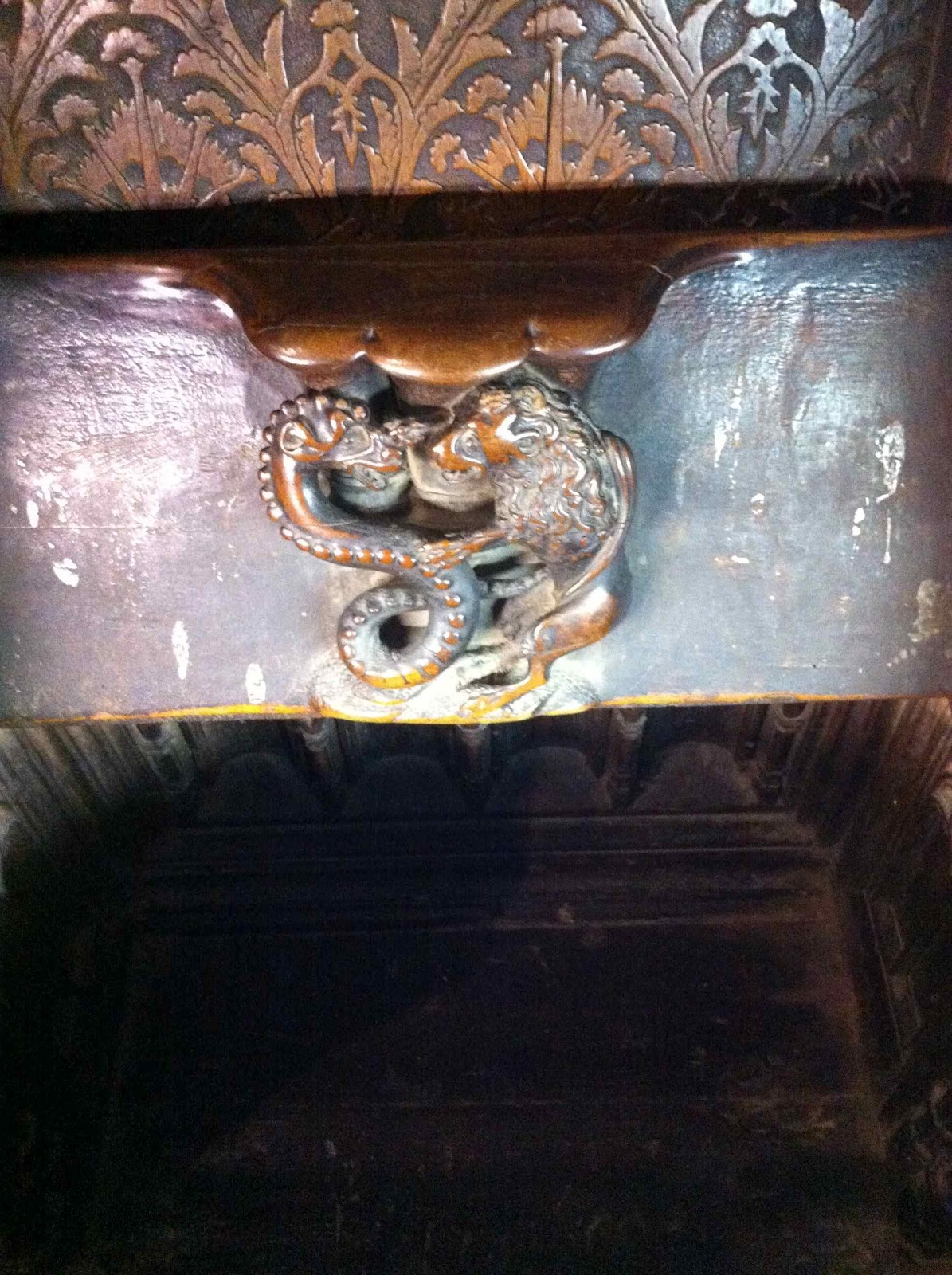
Just the choir area took me 30 minutes to look at all the carvings - and the miserichords are just awesome! On the backs of the seats, the battle to retake Granada is depicted in glorious detail. And here's a mythic battle taking place, just underneath those tired gluteus maximus muscles!


 Back out on the streets I headed away from Christianity and lost Muslim buildings and in search of Toledo's Seffardi Jewish roots. My initial search was diverted however by a more edible goal : this is the convent of Santa Rita, and they sell the Tears of Santa Rita, made by nuns ......and having just scoffed a few, I can assure you they are very very tasty indeed. She must have been crying for joy, and not from sadness! They are a local Toledano delicacy made of marzipane  and gently toasted in an oven. The nun who handled the sale was securely barred behind many layers of iron work portices with an intricate rotating cabinet with chain operated door..... to ensure that they have no opportunity to sneak out, I assume. Or get contaminated.....or simply, for the joy of the technology perhaps!

 Finally finding my destination, I visited the local Seffardi museum once a synagogue, and then went on to Santa Maria La Blanca - which is the oldest synagogue building in Europe, and is now owned by.....the Catholic church. It's got a large cross on the central wall and a very stern looking nun is sitting trying to push religious card sales on the sidewall. All this doesnt detract from the beauty and simplicity of the carving on the walls though - so very different from the  complexity and gilt on display in the cathedral. Its still a quiet and peaceful place, pleasant to visit, but curiously disjointed with its blend of tourism, art gallery and different faiths.

Toledo is famous for more than just buildings though, and its crafts are known thoughout the world. Damasquina - or the creation of gold plate designs on a steel backplate is alternately tacky in it's machine made tourist trap glitz and stunningly beautiful in the complexity and fineness of craftsman ship in its handmade sister. I got to see a number of craftsmen at work, and the skill required to do some of the more complex geometric designs is just astounding. The other famous output from Toledo is steel - nice sharp pointy things to cause much damage with. On every corner of every street is a shop selling perfect replicas of so many historical swords ( and mythical ones too - I had to giggle when a sales girl told me that their excalibur was a museum quality replica of the original!) - and of course armour galore!

Onwards next to Segovia..........