Showing posts with label DIY. Show all posts

Monday, 30 May 2016

How to edge a river bank to protect and shore your garden from erosion

One of the mixed blessings of living in the Netherlands is the large amounts of water. You are never more that than a stone's throw away from a canal or river or ditch, and it's almost inevitable (if you live outside the major towns) that you will end up with water running near your property. In our case, we are bounded on 4 sides by drainage canals that form a small part of a complex drainage system that keeps this below sea-level corner of the Netherlands dry. It brings joy with an ever present procession of wildlife - we have ducks, moorhens, swans. coots, kingfishers and herons all within a few steps outside our door.

However with the constantly moving water, and the annual commitment to dredging out of the canal to ensure silt doesn't build up, erosion is a real and present problem. Around the fields, it's easy to see that the waterways have widened significantly over the years. Around the house, the banks are managed on one side by a line of mature lime trees, who's roots have bound up the soil tightly and act as a natural edging. At the front however, you can see the remnants of the old 'beschoeing' or river edging with a few rotten spikes intermittently sticking up about a foot or more away from the bank. When W had to mess around in the water to put the new gates in, he found out the hard way that whilst the main canal is shoulder deep, the old edging has slowed erosion sufficiently that there is an underwater bank that is only knee high deep. Sadly we weren't quick enough with a camera to capture the experience - and with forewarning, no-one else seems sold on the idea of recreating it.

We decided that we wanted to replace the front edging for two reasons - one, to stop the erosion and stabilize the banks and secondly to limit the amount of damage the resident muskrats are doing to our front lawn. Muskrats are avid tunnelers and leave as comprehensive a set of networks as your average mole - but significantly larger in diameter. These regularly collapse, scenting the air with a tempting aroma that no self respecting Great Dane can ignore - triggering some mad digging by one of the most efficient canine-destruction machines you've ever seen : a GD puppy on the hunt!

Lots of research later we decided that doing it the old fashioned way - by hand - would be the way to go and that we felt confident to do it ourselves with lots of help from the lads. We followed plans from http://www.bakkerdehouthandel.nl/ and had all of the materials delivered from them. (All credit for the graphics are bakkerdehouthandel and we recommend getting materials from them - they have an easy onsite calculator to work out exactly how much you need!).

The process consists of sinking poles into the basal mud layer. Each pole needs to be 2/3rd sunk, and 1/3 boarding to shore up the edging. The gap between each pole is a maximum of 50 cms apart as illustrated in this diagram

Optie Palen

You then attach boards horizontally along the poles to provide at least one board height above the waterlevel and boards all the way down through the water to the base level of the river. The boards go on the inside of the poles so that the soil pressure pushes them against the supports.
Optie Planken
The boards are attached using bolts to the main poles and a horizontal bracing bar is applied on the outside ( waterside) of the poles to prevent warping and to give additional support for the land anchors.

Optie Gording

Finally you attach anchors into the soil to ensure that the boards & poles have support and don't slide outwards over time. You add a layer of plastic to stop the soil from filtering through the cracks on the inside (land) of the boarding, and you back fill the gap between where you are boarding and where your bank actually is with large amounts of soil. Let it settle, stomp it down, repeat the filling until the ground reaches the level you want. Finally top off the poles with a flat board to give you a more presentable front and an edge to sit on.

Optie Afdeklat


Looks easy, doesn't it? So....no issues, right? Well here's how it *really* went!

The first task was to measure up and plan how much wood and boarding we would need, Whilst nominally this isn't a terribly hard task, given the clear instructions from deBakker, it's surprisingly hard to measure in a straight line, and to balance on a narrow muddy edge when there is a Great Dane  who thinks that the sole reason you are in the canal is to play ball with him. Luca spent most of the afternoon pointedly dropping his ball in the canal and nudging it away into the middle of the canal whilst staring pointedly at poor W - who was freezing, grouchy and not happy with his childhood flashbacks of retrieving balls from water!

Once the wood order and the crew had assembled the next challenge was how to assemble and put together the frame. W & team quickly decided after advice from our neighbor F that the way to go was to assemble lots of individual panels on dry land, to attach the large flat boards on to the main poles and to sink each panel as a block into the muddy base. They then chose to attach the reinforcing strip once the panels were in place and to do the same with the mud guard plastic and the anchors.

The first panel made it quite clear just how TOUGH a good hardwood is - and you definitely don't want to be using softwoods underwater. Within the first 3 hours, we had burnt out 3 drill bits and burned out the motor on a deWalt rechargeable drill. Knots and just the sheer number of holes needed made this an incredibly tough activity. Note to the wise : you want to drill slowly and steadily, not at max power, and take time to clear the drill bit of sawdust regularly.
Eventually the team got into a good steady rhythm that allowed consistent progress, without destroying machines & tools. All the movable woodworking tables that W has made over the last few months came into their own and we were able to use them outside in the sunshine to get maximum throughput Here's the assembly line in progress!

With the first panel done, the team decided to try placing it immediately to work out what the challenges were ahead. The dream team grabbed the first panel- with all of their proposed boards attached to it and headed out to the water to start sinking it into the riverbed. They very quickly realized that a) its remarkably hard to hammer 5 poles in simultaneously  and b) when you screw up on the location, and have to move it sideways, it's REALLY hard to pull it back out of the mud to re-position it! We learned a valuable lesson early on : be willing to improvise a little on measurement - sometimes although the letter of the law calls for 5 boards, reality of the river bank only allows 4! We also learned that the action of hammering the poles caused the tops to split and crack quite a lot. Luckily we had purchased extra long poles, so by moving the board placement further down, we gave ourselves a much longer level of pole at the top, that we could cut off later on with a reciprocating saw. Easier to hammer, and less traumatic when you splinter off chunks!

After first day creating panels, it was back to the task of placing them in the river on the second day. Unfortunately the remnants of the old 'beschoeiing' rapidly proved to be a problem, with the old collapsed frame getting in the way of the new poles. Electric tools and water don't really mix very well, so we had to revert to good old fashion hand tools and my trusty bow saw for tree surgery got called into action. Luckily the weather was on our side with glorious hot & sunny days making up for the fact that water was glacially cold and very very very murky! Each footstep through the mud released methane from the decaying plant materials making the whole exercise particularly fragrant!

At the end of the third day we'd completed fitting the right hand side of the bank and discovered some of the challenges we had created for ourselves with sinking the gate posts into the water. It wasn't too much of a problem to the right of the gate as it was not far overhung, but on the left we had to do a long diagonal slice around the fencing and come up with new creative ideas to stop Luca from traversing out to freedom.

 The dream team also came up with interesting ideas on how to balance out across the water, in order to keep momentum and power behind their sledgehammer strokes when the bank and boarding had significantly parted company. It gave us inspiration for a later innovation : the cat scramble board or duck boards - to help animals which don't want to remain in the water to get safely out. As both Lumikki and Jesper had fallen into the canals within days of being allowed out to roam, I want to be sure that the wooden edging doesn't have fatal results when one of them misjudges their steps.


Once all the boards were in, it was time to attach the plastic material that stops the soil from trickling away. This is done on the inside, along the line of the main retaining baton. Once attached,the main retaining strip put in,and the ground anchors attached, it was time to start to long hard graft of back-filling the soil gap. Luca had decided early on that it was HIS fort, and that he was the king of the castle! It gave him a perfect location to supervise the work that everyone was doing and to provide his own personal commentary to the proceedings!

Once back-filled, we took a few days off to let the soil settle, and to find out if we'd missed any sneaky corners where the soil was trickling away. This seems to be an inevitable part of the process, and we were lucky to only have one 'leak'. Once settled it was top up time then we needed to remove the top extension of the pole down at the board height and to attach the flat board over the top to finish it off. Whilst initially the boarding looks really 'wonky' - wavering all over the place with no real straight lines in place - once the retaining bar and the top was laid on, it was amazing how much the movement disappeared. From the far side of the river, it looks beautiful and smooth with a gentle curve that mirrors the shape of the land.


5 days of hard work later (plus a few waiting days ) and we ended up with a beautiful new canal edge. The observant among you will have spotted the extra special add on that we made -  I'll talk more about in a later post - a fishing boardwalk!


Tuesday, 10 May 2016

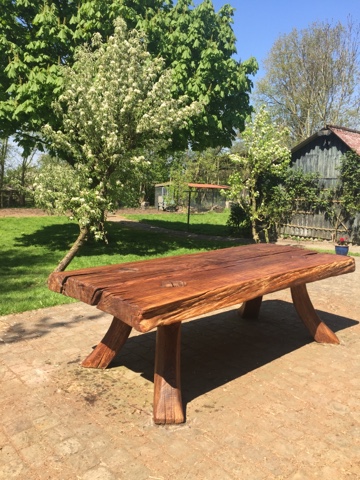
Restoring a grand old table part 2 : garden table renovation


Our beautiful table is done! 

W has spent lots and lots of hours working on her. After the rough sanding we covered in the last blog, he focused on the legs as the easiest place to get a solid sanding routine going. Starting with a 40 grit, then working his way through 60, 80, 120, 180 grit and finishing with a delicate polish on 320 grit. The legs came up magically smooth and incredibly tactile as a result. Working on the underside was hard and dusty work - I'm still not sure how he managed to wear all that safety gear and still work in the blazing sun and heat we've just had. That said, it's a remarkably good idea to have the face mask as there was a lot of dust flying around. He has repeated the process on the main table top surface and she is just glorious.

We've coated her with 3 coats of Danish oil - the first cut with turpentine oil to carry the oils deep into the surface. She drank the first coat in like a lost man coming to a bar in the middle of the desert - we went through more than 3 times as much oil on the first coat than on any other coat. It's sticky horrible work, and it's impossible to get Danish oil off your skin - but it was worth every minute we had to spend in the shower sanding it off ourselves with crazy amounts of scrubs. It is almost impossible to capture the way the table glows in the sunlight - she looks beautiful in the pictures, and is so much better in real life. 

Time to get a glass out and chill in the sun! Next project has to be to make up some chairs to go with her ..........we still haven't worked out what the wood is, so if anyone can identify it, please let us know, so that we can make the chairs from the same source. 


Thursday, 28 April 2016

Restoring a grand old table, part 1

We have inherited the most beautiful picnic table you've ever seen.

It's huge, it's so heavy that four of us can't move it, and it's top is made out of a single complete slice of a very large, very mature tree. You can see the growth rings so clearly, marking every year that this giant stood and watched over the earth.  Sadly, now that it is a table, it has had very little love and care over the last few years, and the top is cracking badly, the edges of the table are crumbling away and there is mould and lichen and rot building up in the crevices.

With all the work that W has been doing with wood, he's been falling more and more in love with the beauty of wood when it's loved and cared for - and this restoration has been high on his priorities. With spring here, and summer barbeques coming, we both really want this baby back at its full beauty.

We spent a lot of time researching how to best rescue it and had advice from many different sources. Many people suggested powerwashing it - but the surface is so broken, we are both quite worried that power washing will degrade it further. It also won't address the way that the surface is flaking in a consistent and gentle way.

We decided to start by sanding it sufficiently to remove the rotten and broken layers, and I will be spending a lot of time clearing out the crevices with a dental pick and a craft knife. W started  on the side that was most rotten and you can see just how much difference it's made already.

After a day of hard work we now have  the top and sides rough sanded. Here it is, halfway through. We still need to do the legs and the base, and I have to get to work clearing out all the crevices .I've started work on it, and I think I will need to use my trusty crafting dremel on some of the larger ones but many are so narrow and deep that we probably won't be able to do much beyond removing surface material. I really want the table to have a chance to dry out before we treat it with oils & wax to stop the rain from damaging it further. We are toying with a plan to put a frame around the table with waterproof covers so that the table can breath and dry out a little before we move  - or maybe we will just pitch a large tent over it. Either way it needs to be easily removable so that it doesn't add to the problem by creating an even moister environment that it sits in over extended periods, and it can be easily shifted on sunny days.

Here she is sanded roughly at the day's end - can't wait to continue! If any of you have done a project of this sort, - restoring old timber like this -  do let us know in the comments of what you think would be the best approach. I want this beauty to last another few decades yet - or longer!

Thursday, 14 April 2016

Making a workbench for a mitre saw

This winter has definitely been laying the groundwork for the heavy lifting we will need to do next year when we take on the new levels in the house. Tools have been at the heart of everything - whether they are garden tools or woodworking and DIY tools. W has spent hours poring over reviews on the interweb before deciding on each and every purchase. The tools aren't enough, though - you really need work benchs for tools to be able to work at their optimum level.

As a result, W has been busy making up a workbench to run the mitre (or miter, if you are american!) saw on. We've had it sat on an old tumble dryer as a stop gap, but it's not really safe and secure, so getting it onto a long term home was quite important.

For doing a lot of this sort of foundational work, W has been using a cheap and cheerful white deal plank that we buy in bulk from our favourite wood merchant. The first task was to work out the measurements - we used an online design as the base pattern , but needed to adjust the height to fit the specifics of the Makita mitre saw that we have, and wanted to make it 4 meters 40 cm  wide, and 60 cm  deep to accommodate European wood sizes. Once that was done, it was chopping time - cutting all the required lengths of planking to size. Then on to using a kreg jig to make the recessed screw holes to fit the 90 degree joins together.


Once everything was ready to assemble, time to get busy with the wood glue and screws. W has made a template to make sure that the corners are at 90 degrees true when being screwed together and you can see it in use here, with clamps holding it in place.


Once the main frame was assembled it's time to move onto the top surfaces. You can see that the sides are both higher than the central dipped area : the dip is where the mitre saw sits as it's got quite a high base. This means that you can support long planks on both sides of the workbench  on the flat surfaceand not have to juggle madly whilst cutting. Definitely a safety advantage! The main surface is a cheap composite board, that can be easily replaced if it gets damaged.


Last but not least, to make sure that we can move the workbench reasonably easily, W added roller wheels at the base. It looks gorgeous and hopefully it's going to be worth it's weight in gold soon!


Tuesday, 12 April 2016

Refurbishing a garden table & chair set - and a little more....


 We have a patio in front of the kitchen which is a suntrap in the spring and in the summer. It's lovely to grab coffee and breakfast whilst sitting in the sun watching the ducks and swans gliding around in the canal.  

Last year, we used a very ancient Ikea table, bench and two chairs which have sat out in the garden for the best part of 3 years - and it was pretty clear that they probably wouldn't make it through another winter if we didn't get some maintenance on them.  I bought them when I moved to the Netherlands and had a tiny garden which I kitted out with a cheap and cheerful set of garden furniture. At the time, I really didn't want to spend a lot of money on the garden, and I wasnt thinking for the longer term, so I bought the simplest furniture I could, and decided that if it needed throwing away in handful of years, I'd still have had value from them. The furniture is looking quite shabby now - the majority of the stain has peeled away, a main slat on the bench has broken away, and there is lichen growing all over them. 

With W itching to play with his new Festool sander, and a beautiful sunny spring day, it seemed like fate! First task was to sand down all the surfaces to make sure that there was no loose material that would discolor or disrupt the new coating. Most of the sanding was done with a fairly coarse grain pad - a 60 grit for the majority of the frames, and the table surface was given an extra smooth finish with a graduated sanding up to 120 grit.


A. had previously found some old wood that was a close match to the broken slat,trimmed it to size and attached it in the gap. W sanded the new bar back to make it fit in as much as possible with the original. Then over to me to wield paint brush and wood stain to get everything painted a cheerful rich green - including Luca who developed green zebra stripes due to incautious inquisitiveness. We ran out of paint half way through, so we had to do a quick run to the DIY store to get a top up.


A few hours drying in the sun and we have once again a lovely table & chairs set on the patio outside the kitchen to have breakfast in the sun. Here they are, ready to sit at and watch the world go by.


Looking forwards to the next weekend!


This weekend, though, I got into a bit of overdrive mode and decided to keep going with the sanding and painting. The side window in the stables has peeling paint - and the wooden frame is getting exposed to the elements. The new sander zipped through the task in no time at all, and I spent the dying light hour of the evening getting the first coat of paint over the newly prepared surface.

 I still need to do another coat so I haven't got a done photo yet, I'll update this page when complete.


Saturday, 12 March 2016

New lights, new shower - home away from home in England


The last two weeks have been pretty manic as I've had a work trip to Canada and the UK, and I tried to sort out some bits back home in England at the same time. Toronto is pretty cold at this time of year, with temperatures between minus 12 and minus 7. When I arrived it was brisk but clear, with no sign of snow - something which didn't last very long with snow coming in quickly on the second day of the 5 day visit. I left before it got too deep in snow, and headed back to 'the other side of the pond'.

The tenants have moved out of the house in Buckinghamshire, so it was time to do an inspection and to do some much needed maintenance - with the assistance of IDD, D and their new grafter, S. As it was also Mothering Sunday, I had planned a quick trip to Cambridge to see the family.

First sight of the house in Bucks seemed pretty good until I noticed a place where the paint was flaking away from the wall in a very characteristic way - water damage! I'm getting far too familiar with water damage here in NL, and a quick exploration quickly showed that the grouting in the ensuite shower had given up the ghost after many years of use and water was leaking through the walls. IDD & D were not in the slightest bit phased by this however - so out came the tools and off came the tiles to find out how bad the damage was. The water had waterlogged the wall, but hadn't caused major damage - it wasn't necessary to completely redo all the plaster. Two days with a hot air blower focused on it lifted the majority of the moisture out and had it ready for re-tiling and refitting of a new shower.

Whilst everything was drying out, I took a quick trip to see the family - and quickly got embroiled in even more repair work. M has had many electricians around to quote to replace her overhead downlights with new LED fittings - and each time, as soon as they have quoted they disappear off the face of the earth. IDD kindly nipped up into the attic to have a look - and reappeared looking quite ashen. After I'd followed him back up, it was quite clear why - the downlighters were a very old model, with bare wires and in many cases had scorched the plasterboard boxes around them - a MAJOR fire hazard. Immediate down tools in Bucks, and all hands to the pumps to sort out the Cambridge electrics the next day. The loft is remarkably small and it's a good thing that D is a lithe and slim young man, able to shimmy around in some of the smallest of places. My task was to run around the countryside finding matching light fittings - apparently very few DIY stores stock enough downlighters to do more than a half dozen lights in one go. Thankfully we did manage to get everything done in one day and M now has a much safer home!

Back to Bucks and on with painting, tiling and shower fitting and a million little tasks like changing batteries, lightbulbs and tightening bolts. Thankfully IDD, D & S took it all in their stride and ploughed solidly through all the tasks whilst I juggled work email, calls and trips to DIY stores. I love the new shower, and the new extractor above it will help to make sure that there is no moisture build up in the small room. Sadly we couldn't match the original tiling, and didn't have time to strip all and start again,  but the new tiles are lighter and illuminate the dark corner of the ensuite. A week later and I'm home, tired and slightly grouchy after a week of sleeping on a very dodgy air mattress!


Sunday, 21 February 2016

The Linen Project - how to make linen water and scent disks


One of the great joys of this house is the walk in wardrobe room. I've never had a really organised wardrobe room, and as I'm a packrat with highly fluctuating weight, I end up with far too much stuff to store in the traditional single wardrobe and dresser. This year, I made the resolution to actually get sorted and back down to reasonable quantities of  'stuff '.

We've spent a whole weekend going through everything fabric and we have another large box of materials to take to the charity shop in Hoorn for recycling and reuse. It's also been a wonderful opportunity to catch up the ironing and folding - and sorting out the room into a vaguely logical order. I hate ironing - with a passion! It is the most boring activity and is designed to waste precious time on something that is completely pointless. But it still needs to be done occasionally -  (read once a year) and this weekend was that weekend.

Steam ironing is the quickest way through the pain. I once bought a bottle of linen water from L'Occitane - it gave a wonderful  scent to the linen that lasted for ages. I've been interested in knowing how to replicate it, but with my own chosen scents for a while. Some quick research came up with lots of recipes on how to create your own linen water - essentially a blend of distilled water, essential oils and a clear alcohol (rubbing alcohol, vodka)  to break up the oils and diffuse them  through the water. Mix, shake extremely well, pour into a spray bottle (bought for 99c at the gRden centre) & voila - linen water!

The fresh linen brings a fresh scent to the wardrobe room - and it's something I want to have there, more than once a year. I'm still not keen on ironing - so instead I've made my own scent disks from a pine root which we dug out of the garden when we remodelled last summer. Once it was dried, W sliced it thinly to expose the growth rings. They are then dripped with my chosen essential oil blend & placed in drawers and cupboard corners. They need refreshing occasionally, but its quite and easy to do so. The disks in the picture are still quite rough, with feathers at the edge of the saw travel : you can sand them to make a more uniform shape, if you prefer. I love them rough and natural, but I do need to make sure they don't get too close to any delicate fabrics that they could snag.

It's been a steamy weekend, but I've got lots of lovely linen & Grandma's lace table runner all ready to go!


Wednesday, 17 February 2016

Fabric design in a mudroom


After finishing the curtains for the craft room, I have started work on the mudroom curtains. I have 2 windows and a door in the mudroom to cover - and the mudroom door is a huge heat loss area. This is despite having put draft sealant around it and all the work we did with insulation during the rebuild. As the paint colors are inspired by the same design see as  as the craft room, I was hoping to use the same fabric. Thwarted  by fate apparently - it's limited edition and the fabric shop had sold out. There weren't many options in terms of fabric and I took a punt on a blue 1970's style diamond design. It's a reversible pattern with one side in shades of  blue and  one in shades of grey - and completely Austin Powers and swinging 60's London - Yeah Baby!


Lots of fun sewing - with Livia now deciding to attack the iron and ironing board instead of the sewing machine. I'm not really happy with the end results though (even less happy with the photo - it is impossible to get an image without massive amounts of white out). My blogs are normally happy blogs of success but I think this one is really a blog of 'must try harder'. I've run out of fabric before I got the third window done, but even so , I don't think I was going to win even with a full fabric haul.  The colors just don't work  at all in the room. They might blend with the paint colors, but they really don't work with the old tiles on the floor. They also don't work with the pine wood work - although that might change when the doors are on and I whitewash the wood. 
I am also not happy with the look of the window/door combination . I've been spending time trying to work out why not - and the only thing I can think of is that it's something to do with fact they are both on the same hanger rail. The rail is quite close to the top of the window and the door - but that's the way I have always hung curtains in the past, and it's never been a problem before. In this room, however, it really truncates the room - and the curtains look squat and ugly. I think I might raise the curtain pole to closer to the ceiling so that the curtains have a longer fall before I try my next attempt. What do you guys think? Help needed here,  I think!